A Faith Born in a Tent: The Story of Brother Luke Ahn
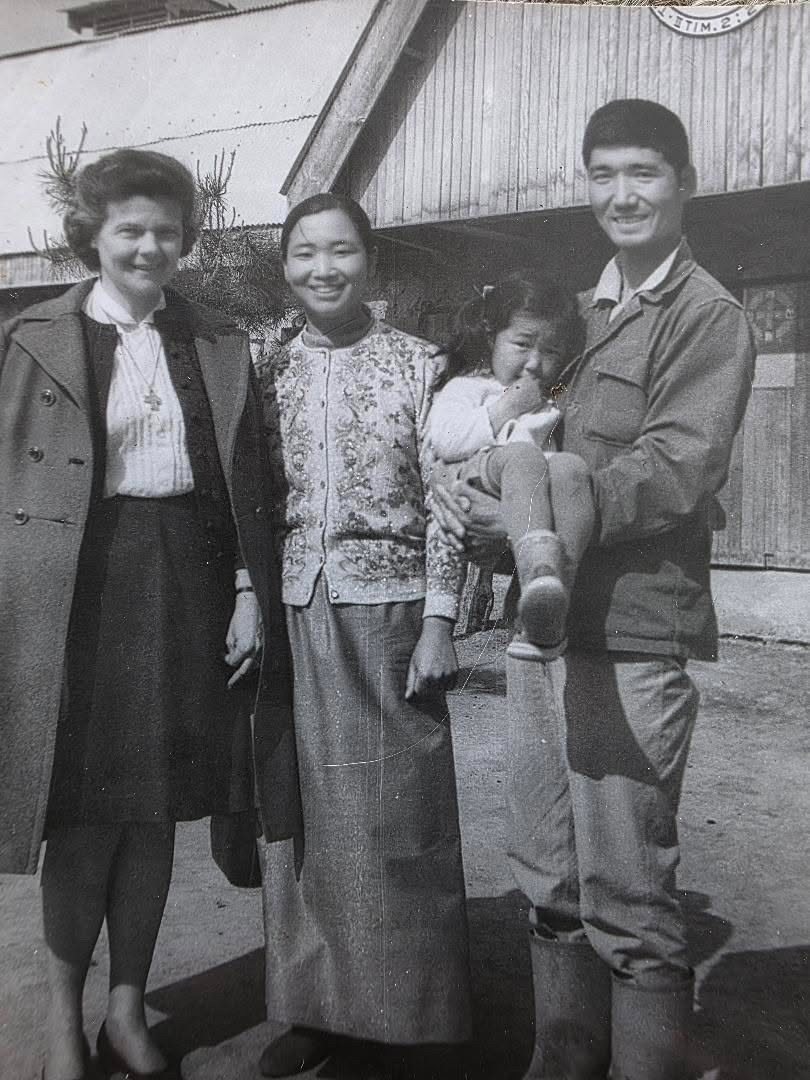
The young man who laid the first stones of Jesus Abbey with Father Archer Torrey, and the family remembered as "Jesus Abbey's first couple"
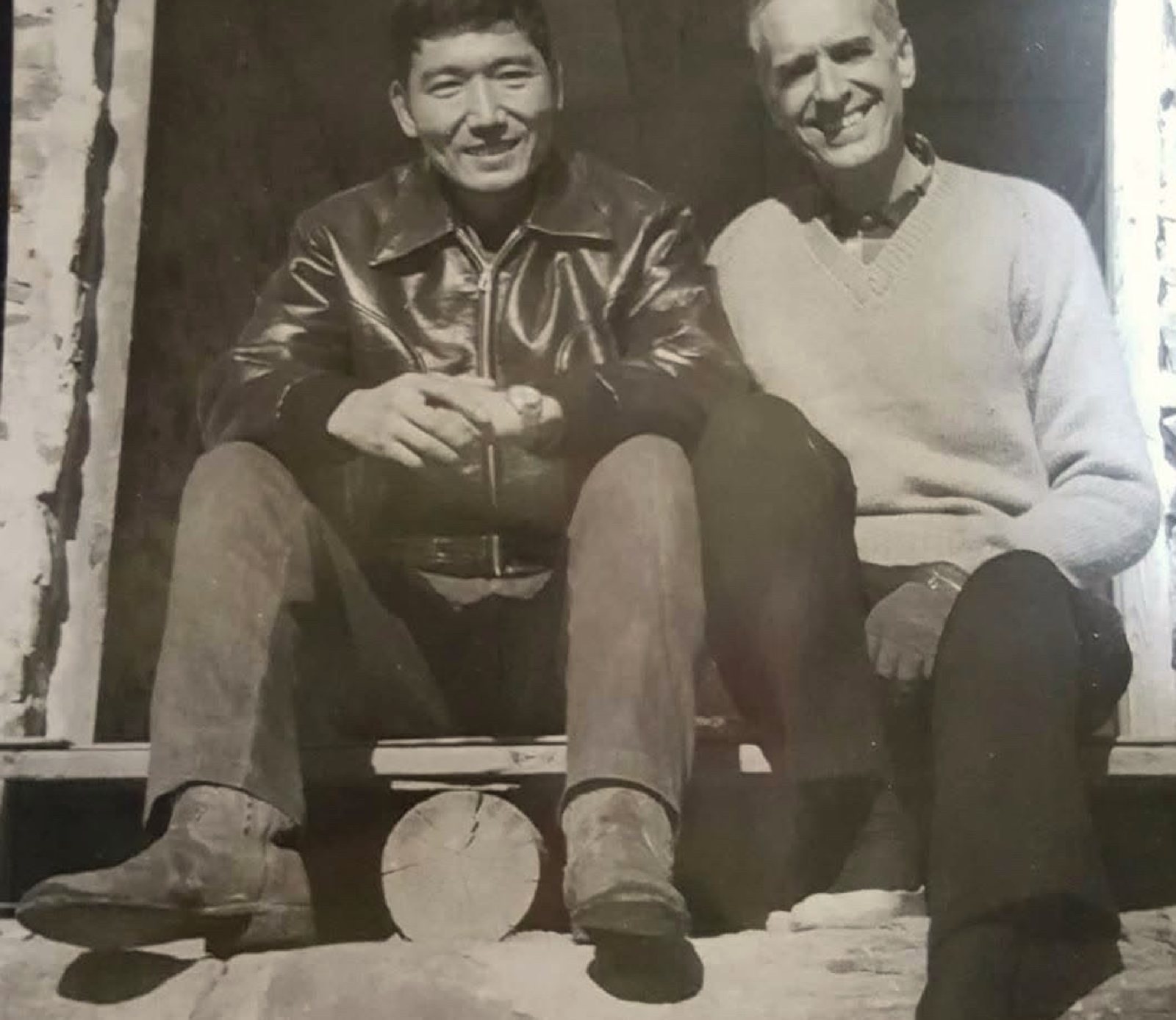
The early days of Jesus Abbey. Young Luke Ahn in a leather jacket beside Father Torrey on a stone step, a log propped beneath it. (Estimated mid-to-late 1960s)
01 · The Meeting
From a Seoul Building Site to Hwangji, Gangwon
Luke Ahn was a young man working on the construction site of a Church of Christ seminary in Hwagok-dong, Seoul. That is where he met Father Archer Torrey.
“I need young men,” Father Torrey told him. “Come with me.” Luke followed, not quite knowing where they were going. The road ended in Hwangji, deep in the mountains of Gangwon Province, where the two of them began building the first house of Jesus Abbey.
Luke did not believe in God. He came to faith while living, eating and working alongside Father Torrey. Before the stone house stood, the community shared a single tent.
His family still remembers: “Father Torrey was very fond of Dad.”
“I remember Brother Luke well.
We lived together in the tent for six months.”
01 · The Tent
One Tent, Twelve People
Father Ben Torrey sent three photographs from those months, along with his memories.
“There was only one tent, not tents. Twelve of us lived together in it for six months.”
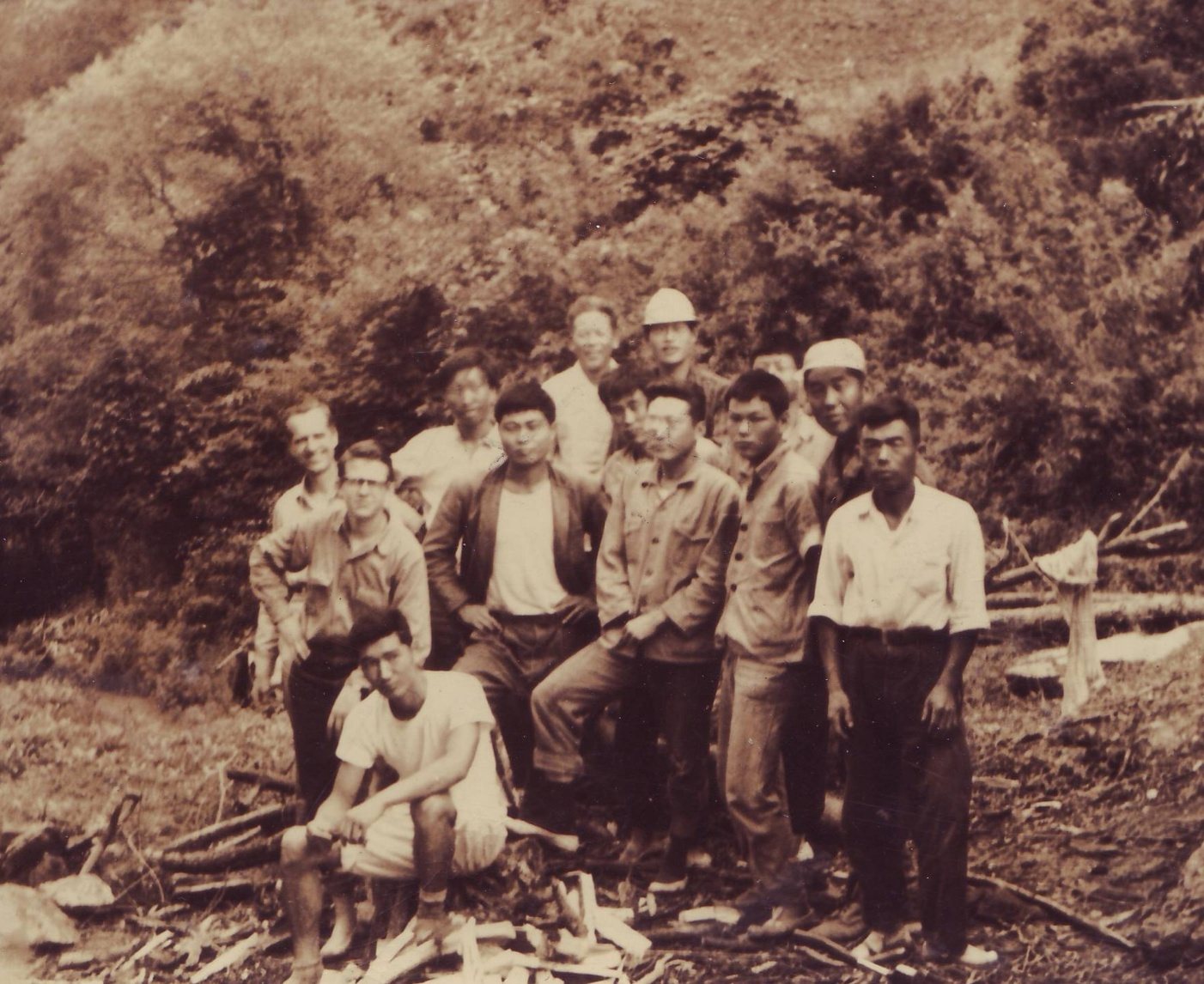
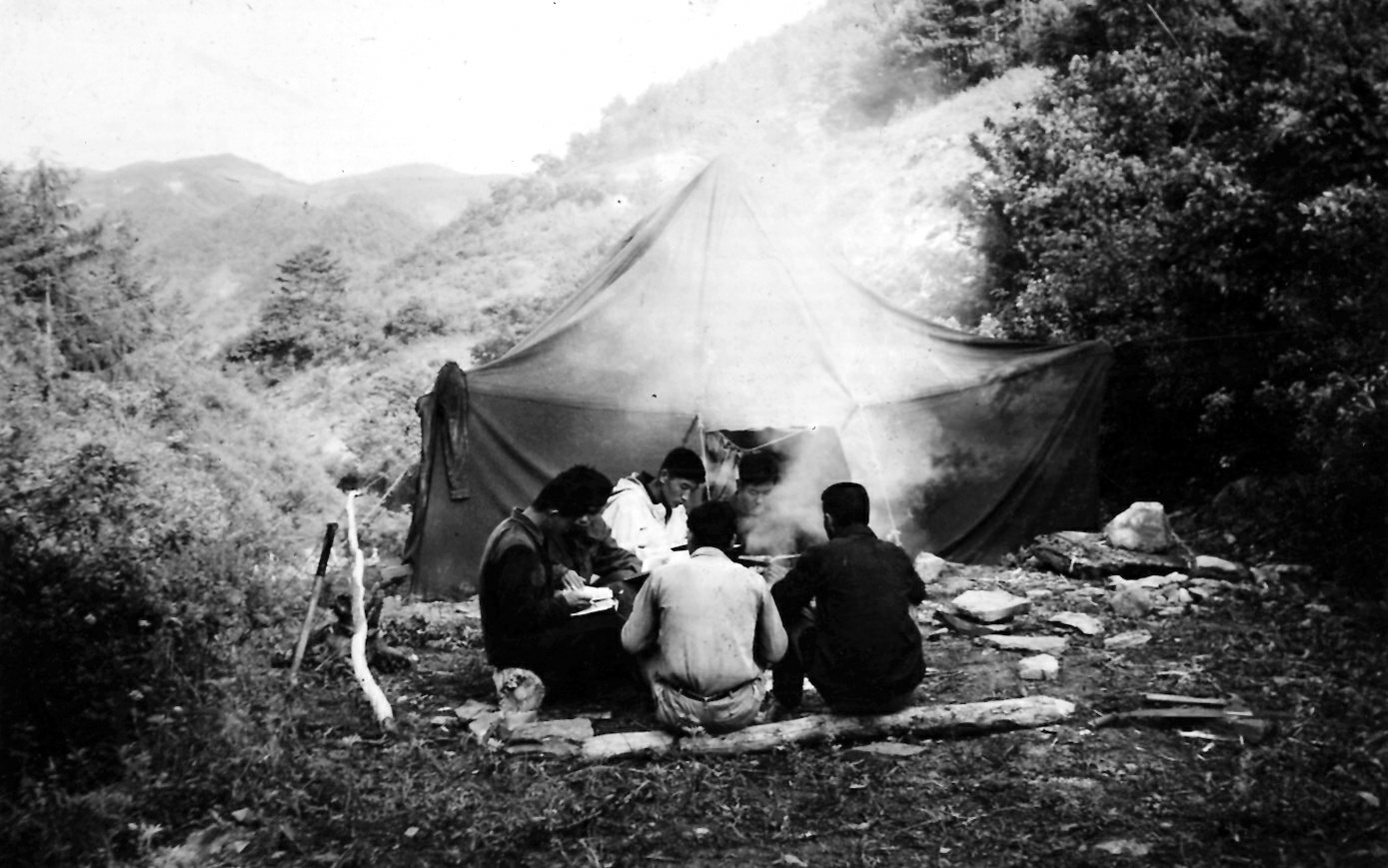
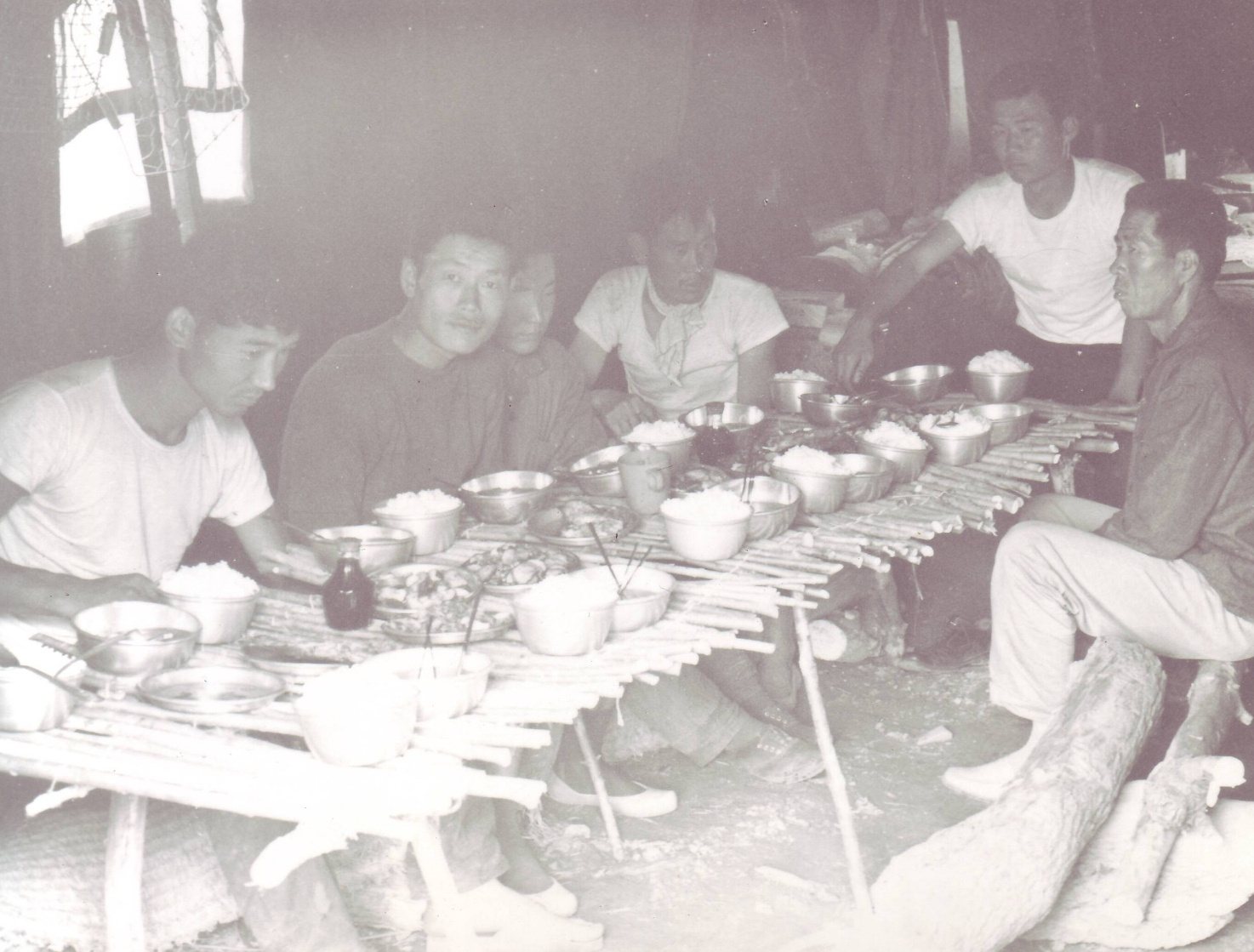
Ben remembers Luke as a hard worker, though not one who did much with the cattle. That was mainly Ben’s responsibility, along with Samuel Lee, who had lost both arms and suffered severe burns to his face from a land mine left over from the war.
Photographs and testimony · Father Ben Torrey (October 2026)
02 · The Wedding
"Jesus Abbey's First Couple"
Once the first building was finished, Sister Cecilia, who was already part of the community, invited her younger sister to Jesus Abbey. That sister was Rachel.
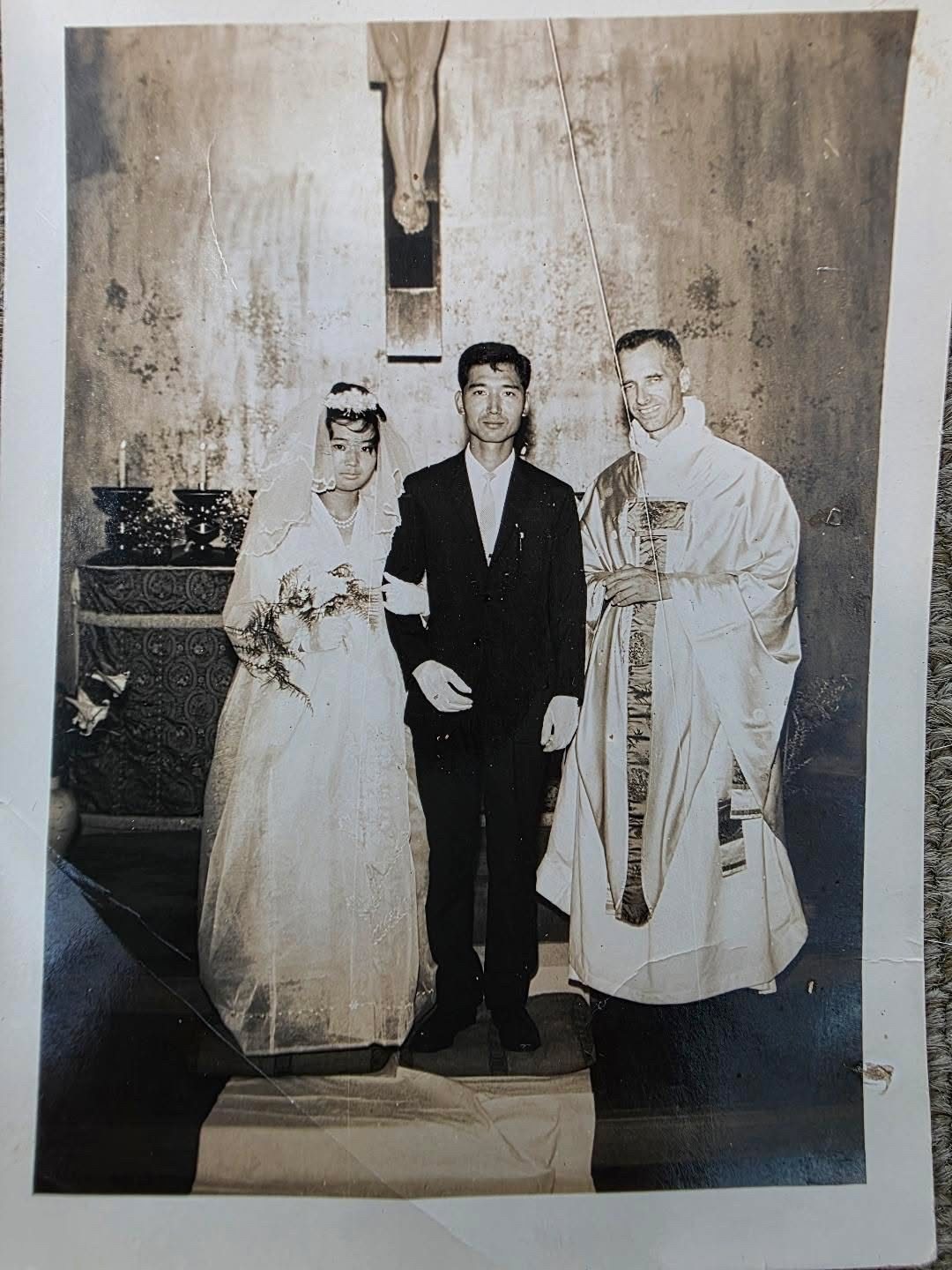
Rachel met Luke at Jesus Abbey, and the two were married with Father Torrey officiating.
“We were Jesus Abbey’s first couple.”
Rachel, now 83, still says this with pride.
Cecilia, who had also lived at Jesus Abbey, passed away around 2024.
03 · To the Dairy Farm
A Lifetime with Cattle
Even after leaving Jesus Abbey, Luke’s life stayed close to cattle.
Missionary Sidney Allen introduced him to the KCC Ranch in Paju, and arranged for him to attend lectures on bovine artificial insemination at Yonsei University. There Luke earned his license as an AI technician.
From then until his death in 2012, he worked his whole life as an artificial insemination technician.
04 · Cows for Korea
Sidney Allen and the KCC Farm
Sidney N. Allen, who brought Luke to the Paju dairy farm, was a veterinarian and missionary, and the son-in-law of L. Haskell Chesshir, founder of the Christian college in Hwagok-dong whose building site was where Luke first met Father Torrey.
KCC stands for Korea Christian College, founded in 1958 by Church of Christ missionary L. Haskell Chesshir (Korean name Choi Su-yeol) and chartered in 1963 as a Church of Christ seminary. Today it is Kangseo University. The school stood in Deungchon-ri, on the road to Gimpo Airport, and in 1966 acquired land in Hwagok-dong. The “Church of Christ seminary in Hwagok-dong” where Luke worked on the building site was this school.
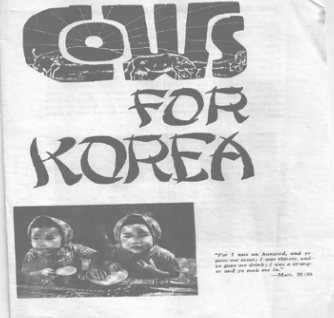
In 1962–63 Chesshir toured American churches with a campaign called “Cows for Korea.” In May 1963, 92 Holstein cows arrived, and that October the college’s dairy, KCC Farms, was founded. In February 1967 the farm moved to about 46,000 pyeong of land in Bangchuk-ri, Gwangtan-myeon, Paju, and 20 more Holsteins arrived in 1969. The milk went to poor families and malnourished children, and helped in the fight against tuberculosis and in the growth of Korean dairy farming.
“The KCC farm ministry was led by Sidney Allen, Chesshir’s son-in-law, with the help of missionary David Goolsby.”
Allen also helped found Hwagok Church of Christ and Hwagok Kindergarten in 1967. At the Hwagok-dong site and again at the Paju farm, Allen was there beside Luke.
Though years apart in age, Allen and Barney Smith, a fellow veterinarian and missionary, were friends, and Allen once visited Smith’s ministry in Rajin-Sonbong, North Korea.
The KCC Farm in Pictures
“Send cows to Korea.” In 1962–63 Haskell Chesshir travelled among American churches with this appeal.
In May 1963, 92 Holsteins donated by American Christians arrived in Korea by ship. That October the college farm, KCC Farms, opened. In 1967 it moved to Paju under his son-in-law, Sidney Allen. This is the farm where Luke came to work.
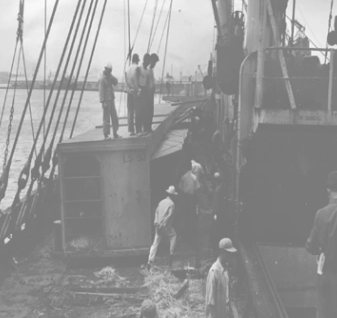
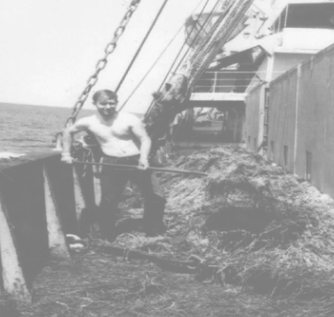
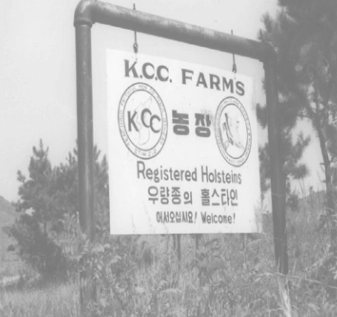
Source · Chambit no. 406 (Nov–Dec 2024, Church of Christ in Korea), special issue for the 70th anniversary of Haskell Chesshir’s mission to Korea, cover and pp. 21–22, 67, 107–108. Allen is described as “his son-in-law, Sid Allen, a missionary/veterinarian” in Haskell Chesshir’s obituary (family blog, 2008). When exactly Luke worked at the Hwagok-dong site, and how he met Allen, will be confirmed in an interview with Rachel.
05 · Back to Jesus Abbey
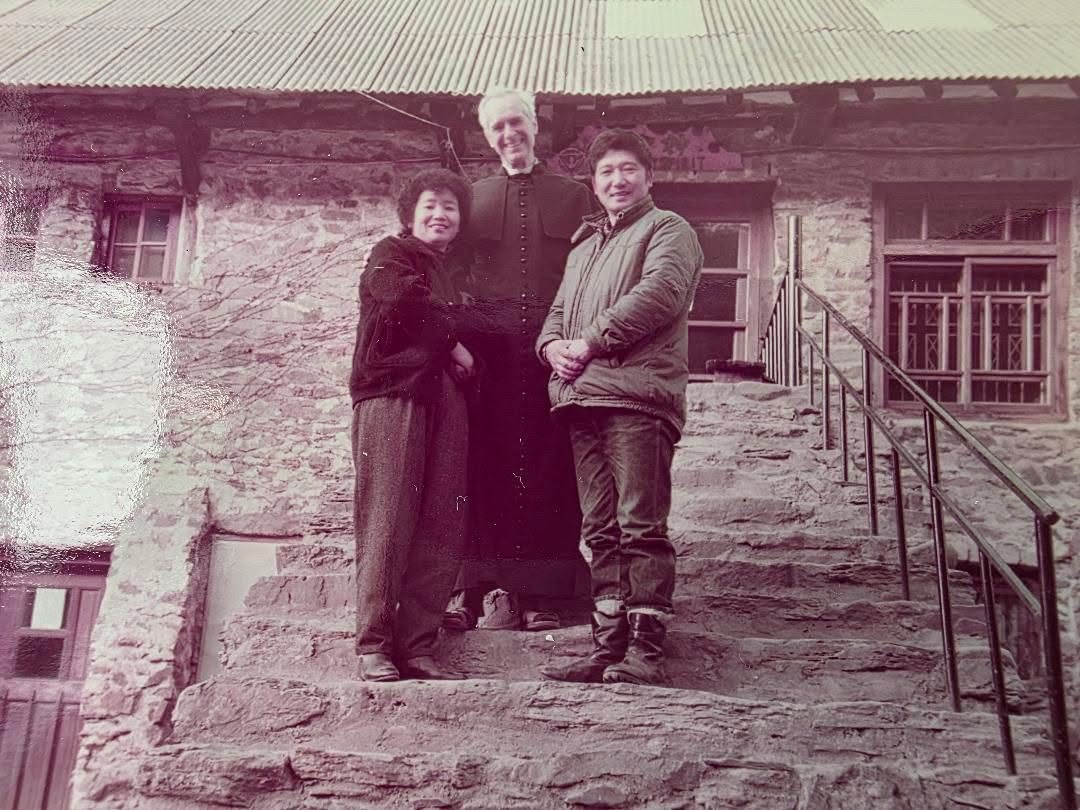
A Bond Kept at Zion
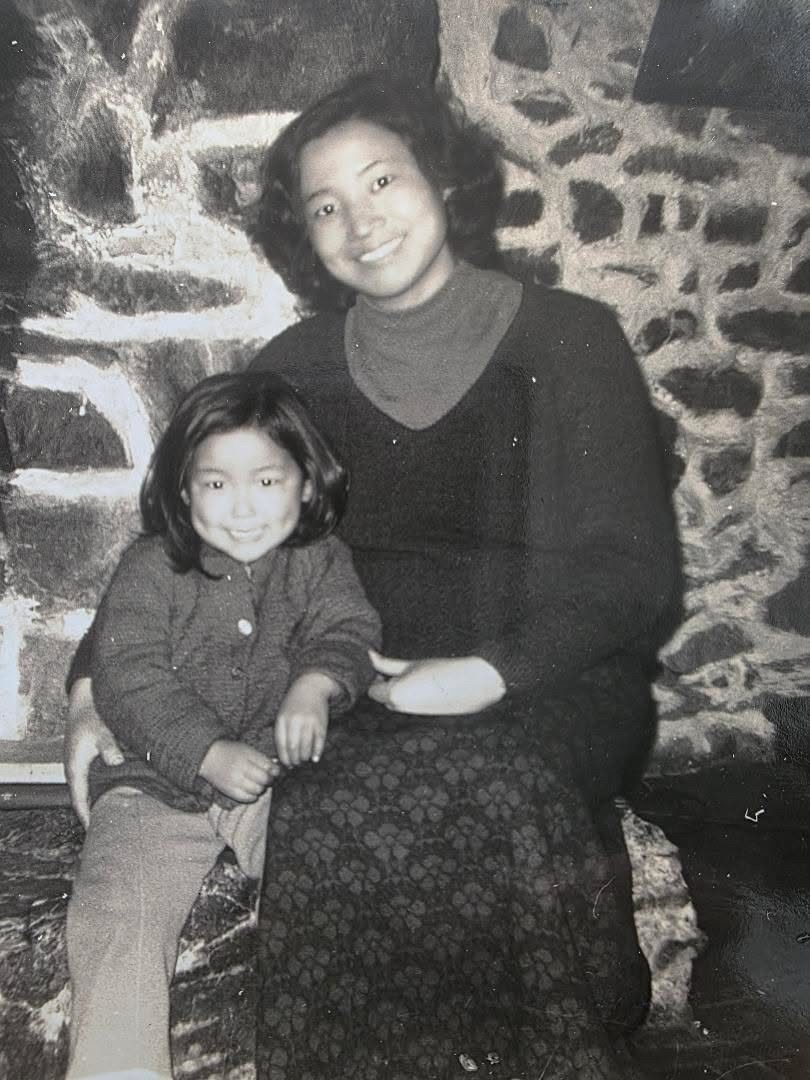
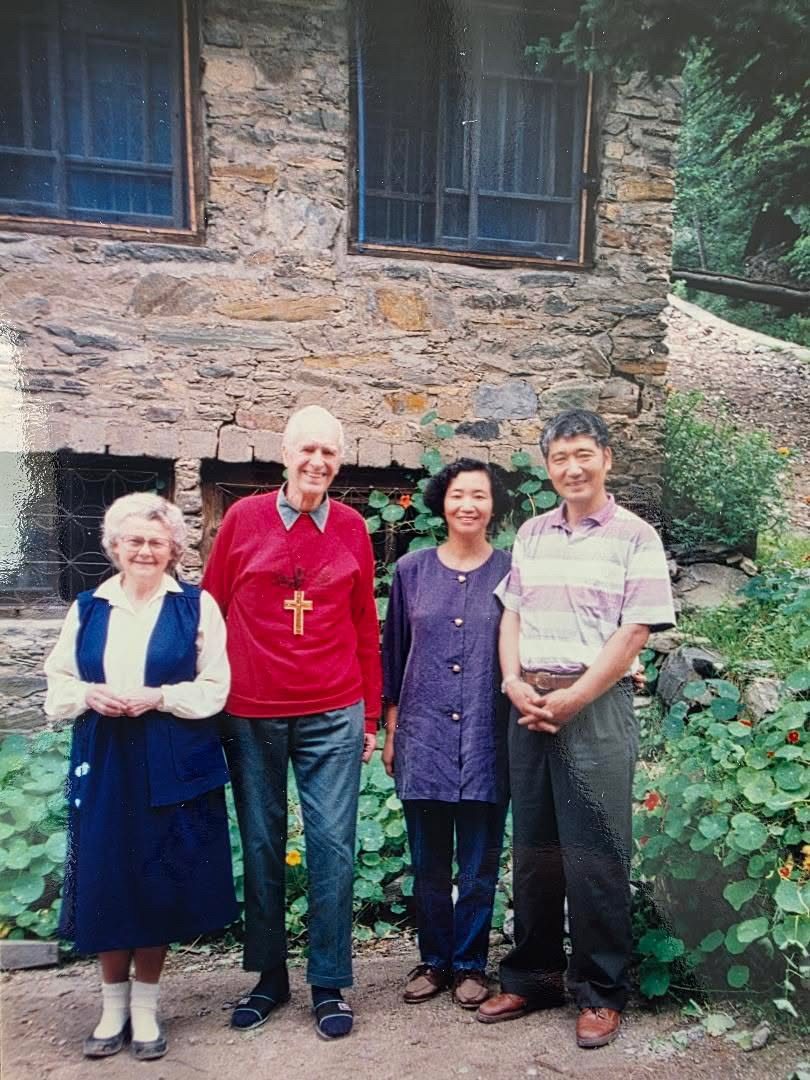
The family returned to Jesus Abbey again and again. Eun-mi at five; Father Torrey with greying hair. In every photograph, the same stone walls and steps of Zion, the stone house, stand behind them.
06 · The Last Meeting
Father and Mrs. Torrey in Hanbok
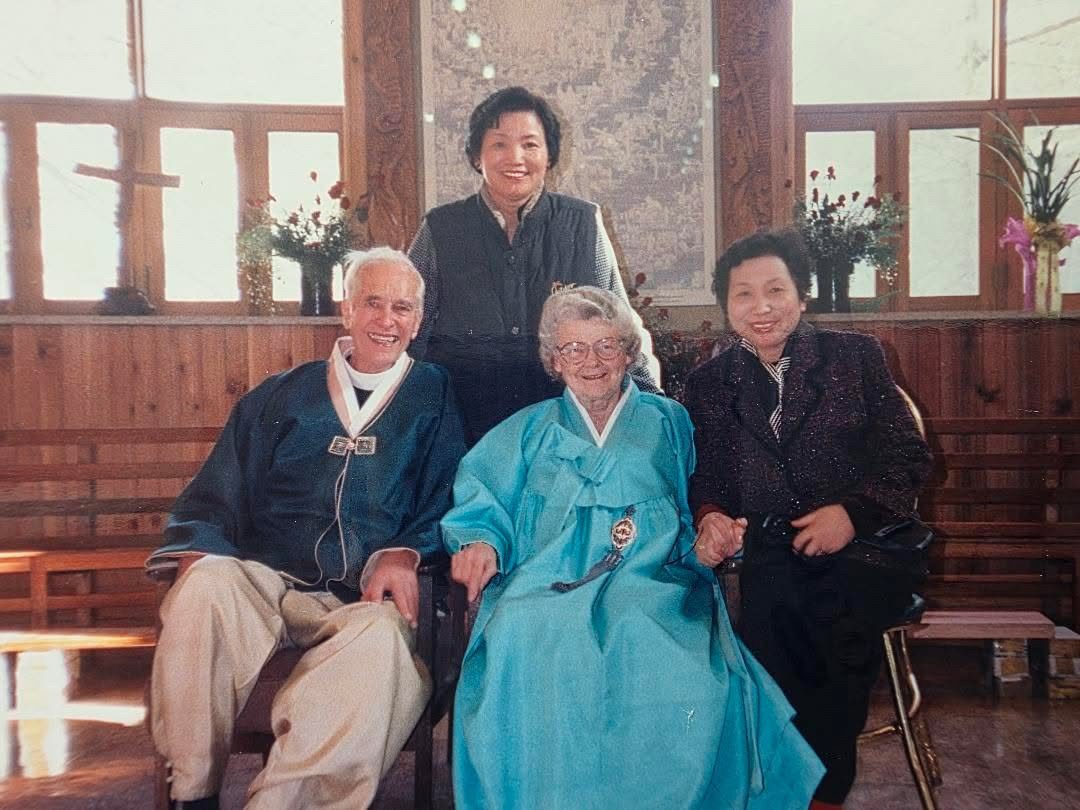
Eun-mi last saw Father Torrey around 1996, at a hotel in Seoul, together with her parents and her husband. A friendship that began in a tent had lasted nearly thirty years.
07 · What Remains
A Single Bible
Eun-mi still keeps the Bible that Father Torrey gave her father. His handwriting remains on the flyleaf.
With earnest and unceasing prayer for Luke.
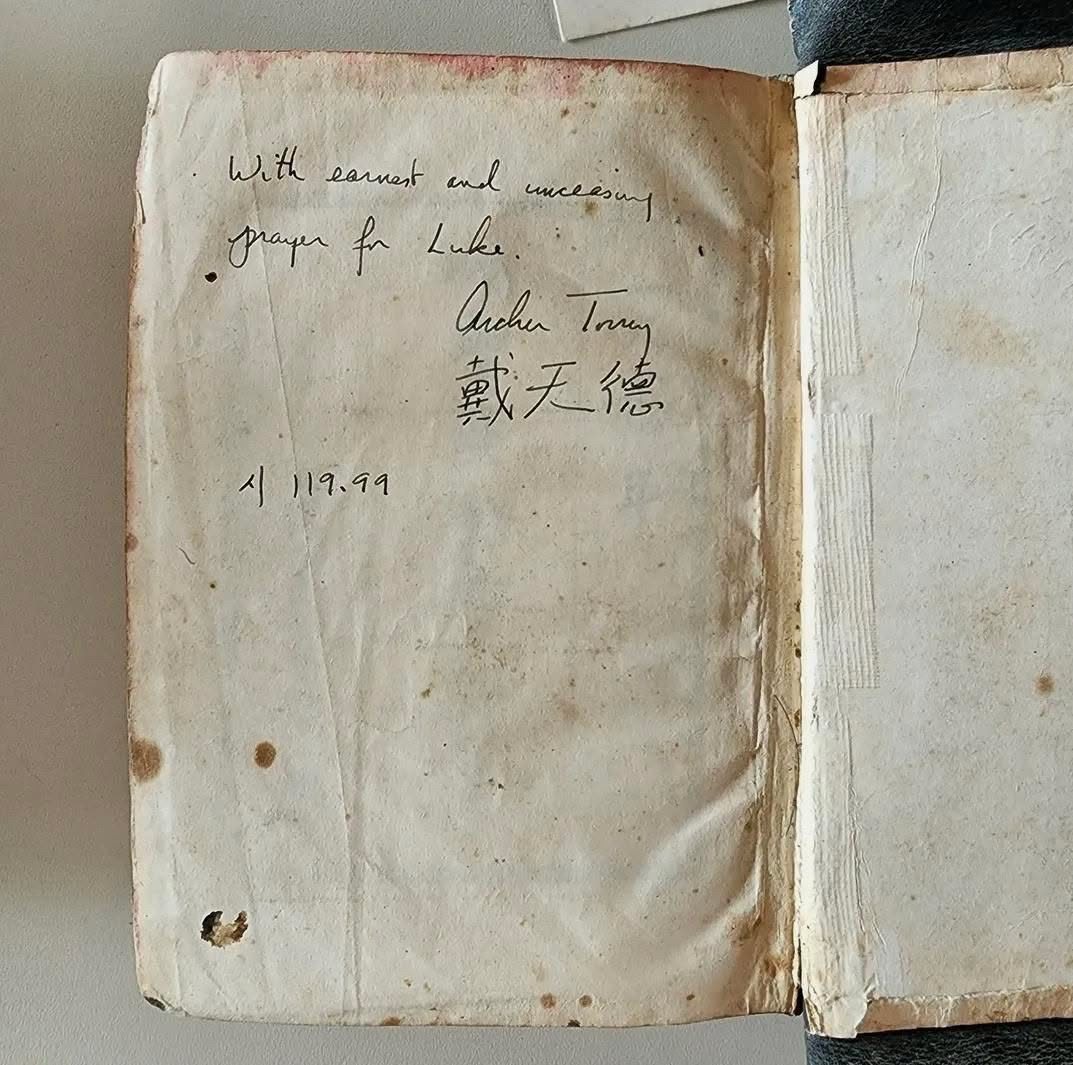
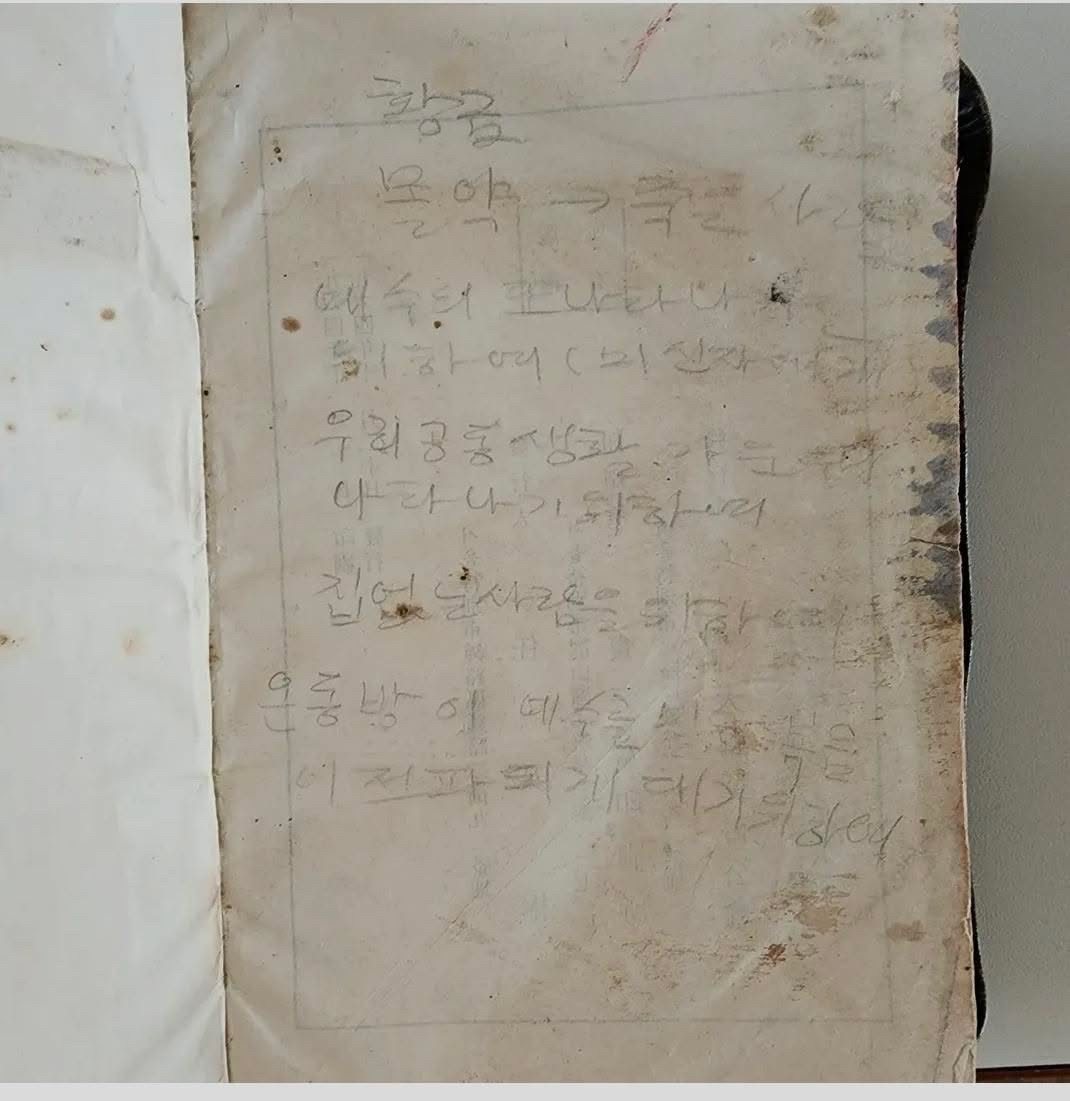
“I have more understanding than all my teachers: for thy testimonies are my meditation.” This was the verse Father Torrey chose for a young man from a building site.
07 · The Good Shepherd
Life More Abundant
Tucked inside the Bible Father Torrey gave was a card. Rachel framed it and kept it for decades.
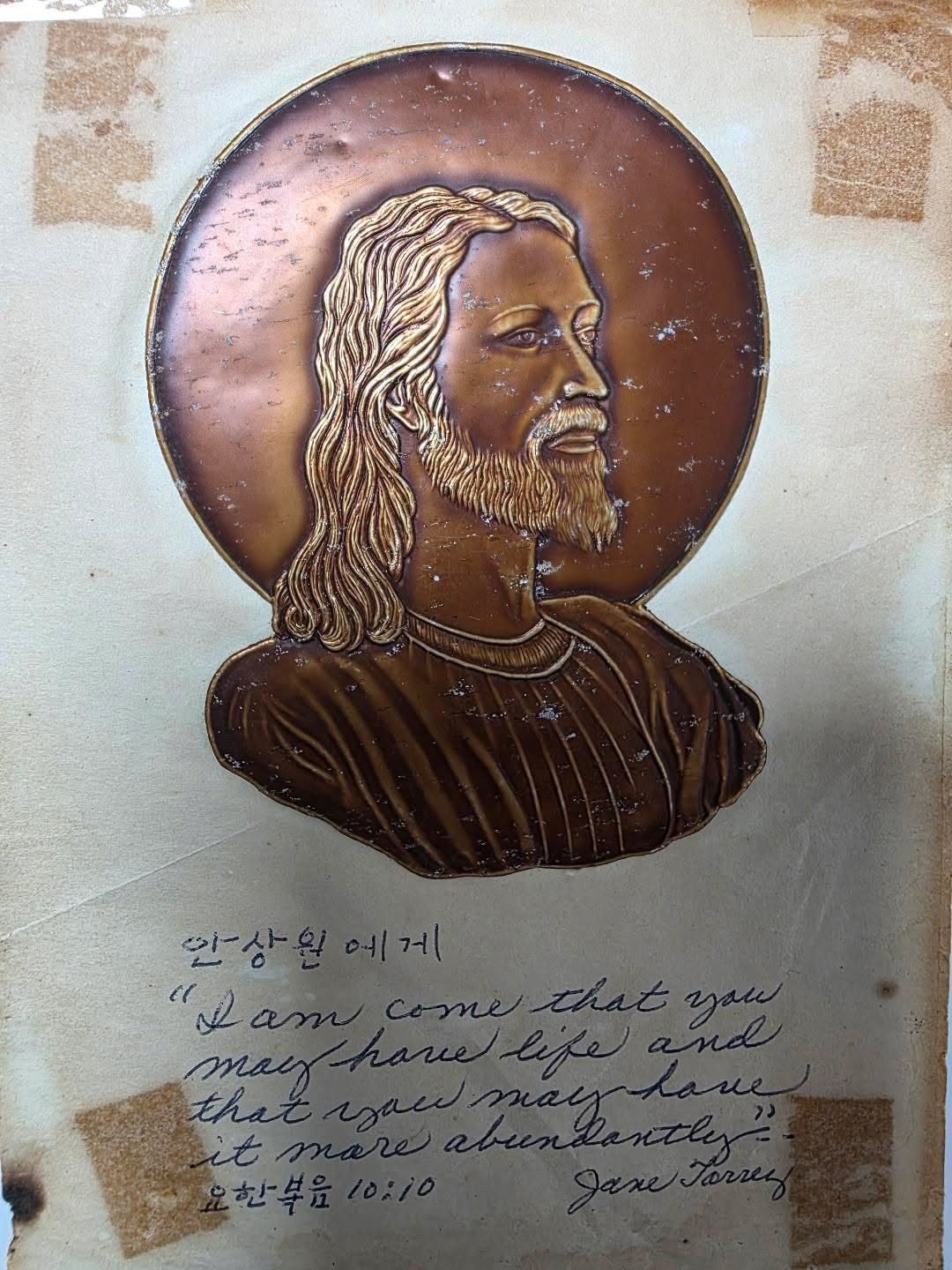
Under a copper relief of Jesus, “To Ahn Sang-won” is written in Korean, followed by John 10:10 in English and the signature of Jane Torrey, Father Torrey’s wife. We don’t know when it was given. Perhaps it came while Luke was caring for cattle at the KCC farm or working as an artificial inseminator: a verse chosen to say, be a good shepherd.
“I am come that they might have life,
and that they might have it more abundantly.”
The verse sits at the heart of John 10, the chapter of the Good Shepherd. Phillip Keller, who worked as a shepherd himself, wrote A Shepherd Looks at Psalm 23 and A Shepherd Looks at the Good Shepherd, reading both passages through a shepherd’s eyes: sheep that follow the shepherd in and out through the door find pasture, and that is the abundant life.
That is the ranch MooMoo hopes to be: a Psalm 23 pasture where the cattle lie down in green fields beside still waters, tended by people learning to be like the Good Shepherd. That this verse hung on the wall of a man who spent his life beside the cattle reads to us like an old promise.
08 · Record
A Family Timeline
- 1963
- KCC Farms founded by Korea Christian College; 92 Holsteins arrive through "Cows for Korea."
- Mid-1960s
- Meets Father Torrey at a seminary construction site in Hwagok-dong and goes with him to Hwangji. Builds the first house of Jesus Abbey; twelve people share a single tent for six months.
- 1966
- Two dairy cows sent by St. Luke's Church in Seattle arrive at Jesus Abbey — the beginning of MooMoo Ranch.
- 1967
- KCC Farms moves to Bangchuk-ri, Paju, led by Sidney Allen.
- Before 1968
- Invited by her sister Cecilia, Rachel comes to Jesus Abbey. Marries Luke: "Jesus Abbey's first couple."
- 1968
- Daughter Eun-mi is born.
- Later
- Introduced by Allen to the KCC farm. Licensed as an AI technician through lectures at Yonsei University.
- c. 1973–74
- Visits Jesus Abbey with five-year-old Eun-mi.
- c. 1996
- Last meeting with Father Torrey in Seoul.
- 2012
- Luke Ahn passes away, having worked his whole life as an AI technician.
- c. 2024
- Cecilia passes away.
- Oct 2026
- Eun-mi finds Samsuryeong Ranch on Instagram and reaches out. Father Ben Torrey recalls: "We lived together in the tent for six months."
The connection to MooMoo Ranch · The first dairy cows arrived while Luke was at Jesus Abbey. According to Father Ben, the cows were cared for mainly by Ben and Samuel Lee. When Luke’s lifelong work with cattle began will be confirmed in an interview with Rachel. Years marked “c.” are estimates.
The hands that laid the first stones of Jesus Abbey became hands that cared for cattle all his life. A story that began on the same mountain sixty years ago has now found its way back to MooMoo Ranch.
Epilogue · Paul Kingsbury
Kim Seung-bae and the Abbey Grange
The man the Kingsbury Project is named for: missionary Paul Kingsbury (1920–2013).
Raised on Chubb Hill Farm in Cavendish, Vermont, he met Archer Torrey Jr., Father Torrey’s father, in New York in 1952. Hearing that Koreans who had lost limbs in the war needed prostheses, he crammed a nine-month course into three months and came to Korea that same year, teaching prosthetic making at Severance Hospital.
From 1957 to 1974 he served as a Heifer agricultural missionary under the Korean name Kim Seung-bae, bringing goats, dairy cows, pigs and chickens to war orphans and poor farm families. From 1975 to 1982 he lived at Jesus Abbey and led the founding of the Jesus Abbey Watershed Grange, building the barn and passing on dairy skills. The family’s house, “Rockbury,” still stands as Seokseong.
About a decade after Luke helped raise the first building from a tent, the ranch moved to a site ten kilometers from Jesus Abbey. Paul Kingsbury was the one who helped set that ranch up.
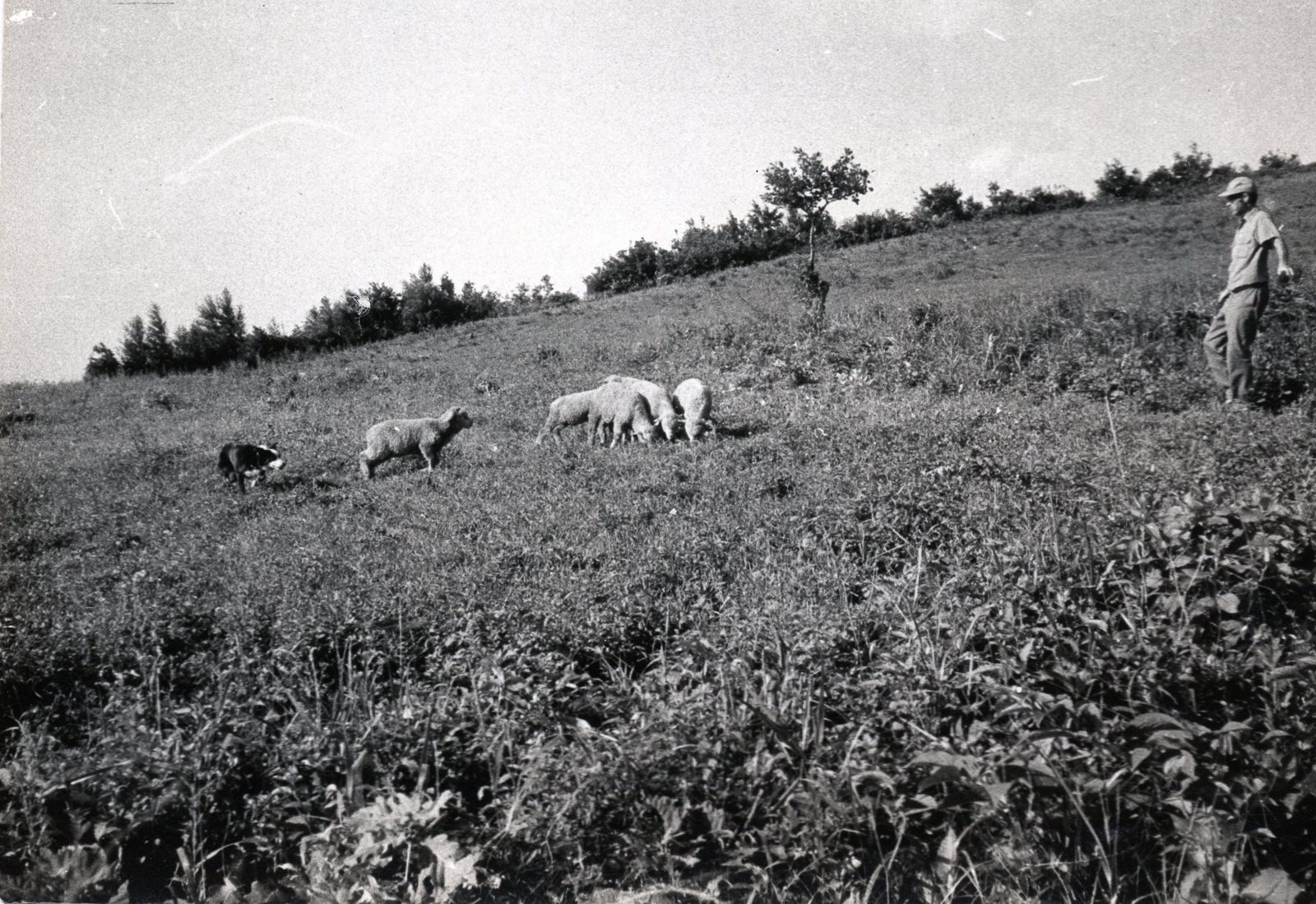
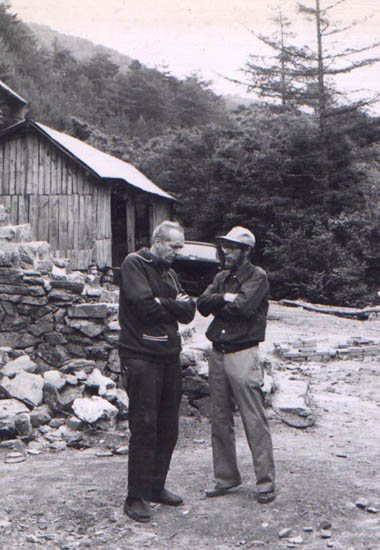
His life is told in full in The Story of Missionary Paul Kingsbury.
Epilogue
Passing On What We Received
Running through Luke’s story is another story: of cows that crossed the ocean.
In 1963, 92 cows sent by members of American Churches of Christ began the KCC farm. In 1966, two cows sent by St. Luke’s Church in Seattle arrived at Jesus Abbey, and MooMoo Ranch began. In a country still poor after the war, milk was a gift for children’s nutrition and the fight against tuberculosis.
On the help that American churches passed on, Korean dairy farming grew to stand among the advanced nations. Along that road were the hands of people like Luke, who spent their lives beside the cattle.
Now MooMoo Ranch wants to pass on what it received. We are beginning the Kingsbury Project, to carry Korea’s dairy system on to North Korea. It is named for Paul Kingsbury (Kim Seung-bae), the missionary who laid the foundations of Korea’s dairy industry through Heifer.
Sixty years ago American churches sent cows to Korea.
Now it is our turn to carry milk to the North.
Epilogue · Sixty Years On
The Feed Silo Luke Built
In the woods at Jesus Abbey, a round stone silo still stands. Brother Luke Ahn built it to store feed.
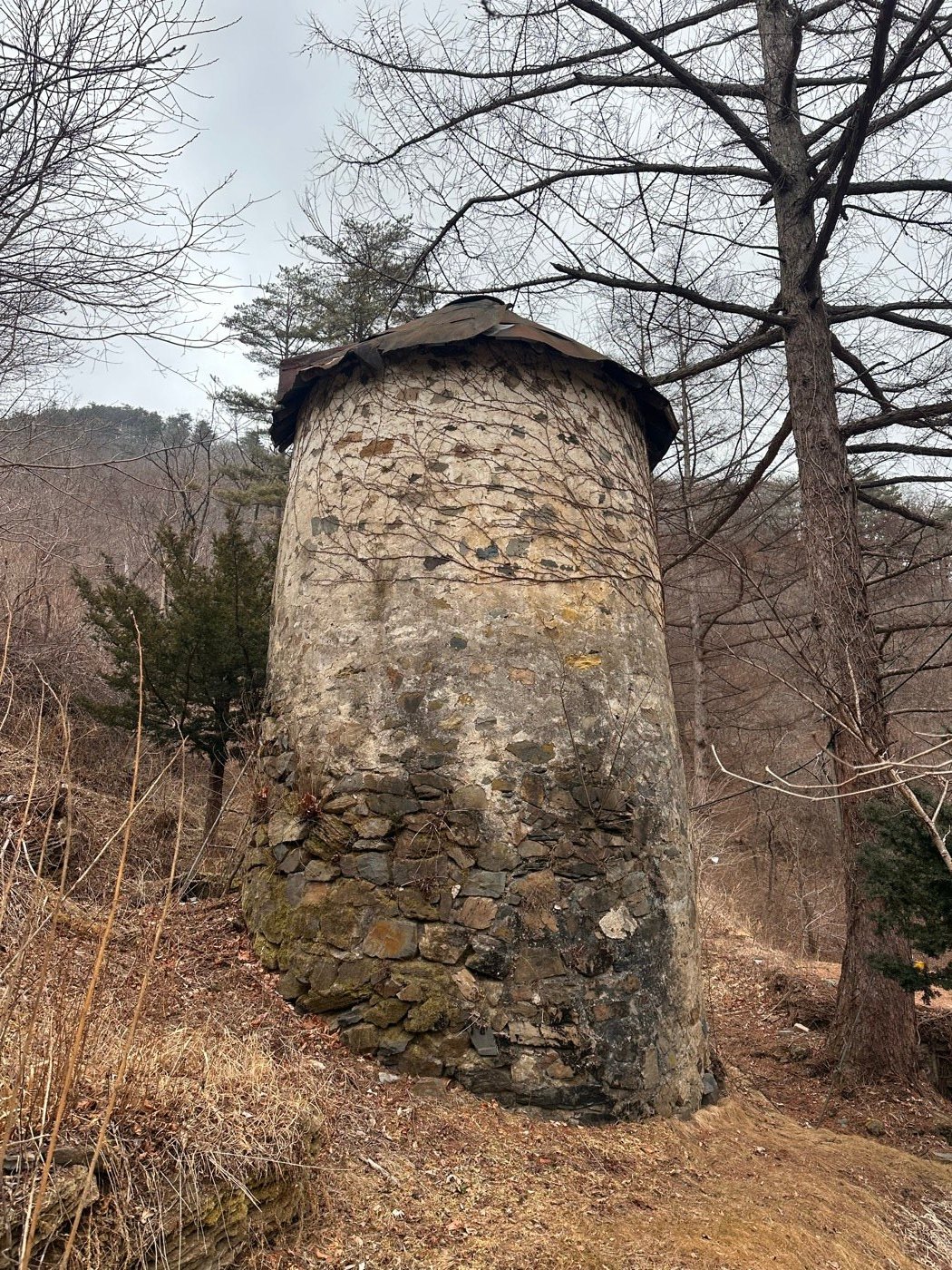
The base is laid in flat stones, course on course, with a round plastered wall rising above. It held fodder for the cattle. The tin roof has rusted and winter vines cover the walls, but the stones have not moved.
The young man who lived six months in a single tent and built the first house at Jesus Abbey also left a store for the cattle on that mountain. Luke spent his life beside cows as an artificial insemination technician. This silo looks like a sign that the bond had already begun at Jesus Abbey.
Stones laid sixty years ago
are still standing.
Epilogue · The Next Generation
Kneeling Again on the Same Mountain
In the small prayer room at Jesus Abbey, children kneel to pray.
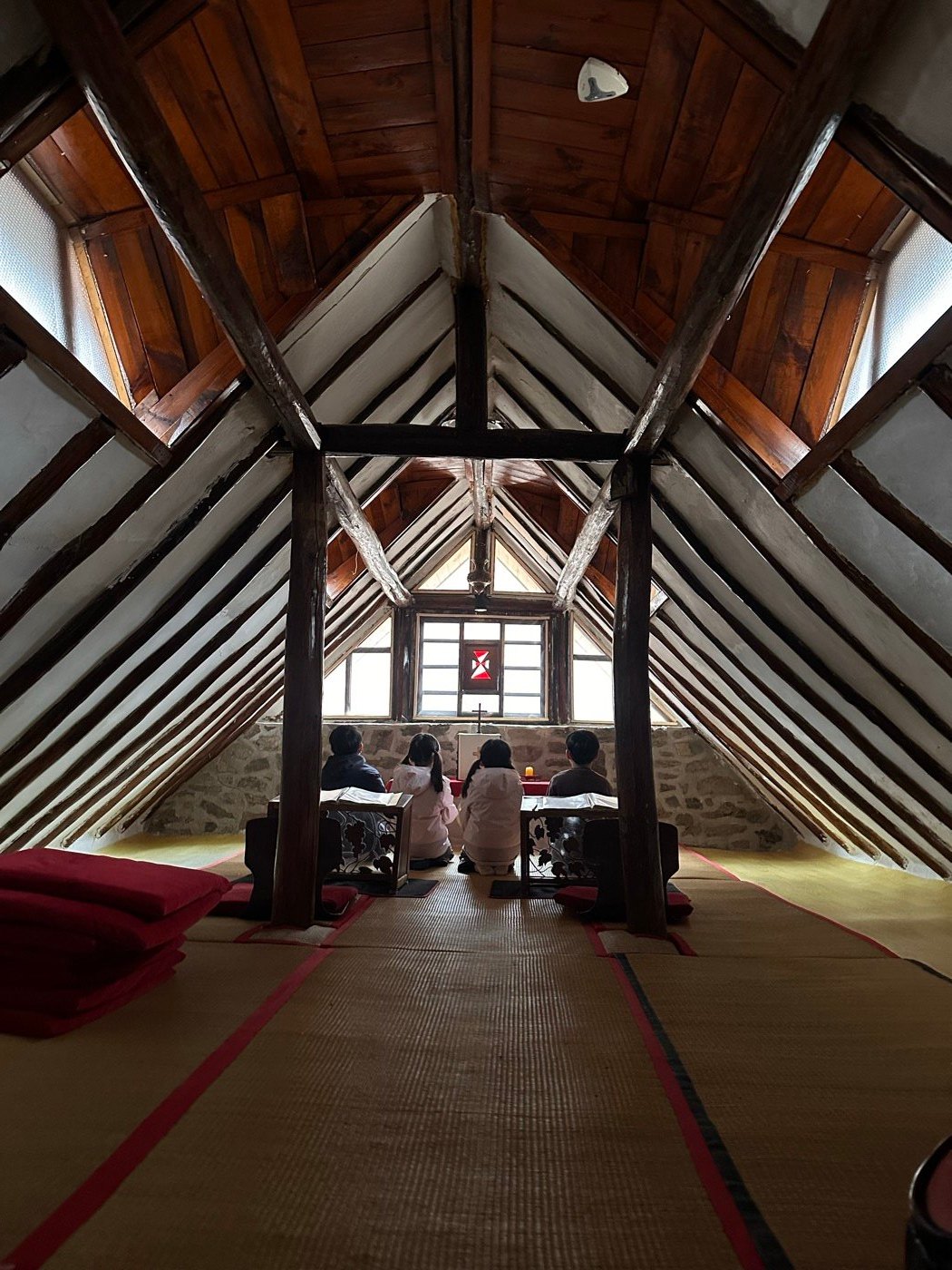
Four children face the stone wall beneath the sloping rafters, Bibles open. The evening prayers twelve people once said in a single tent have crossed sixty years to reach this small room.
On the mountain where Luke laid the first stones and built a silo for the cattle, the next generation is preparing to carry the ranch forward. Passing on what we received will begin in prayers like these.
On the stones Luke laid,
the next generation prays.
Materials courtesy of Eun-mi Ahn | Compiled by Samsuryeong MooMoo Ranch